Thursday, February 28, 2008

Michael Clayton

This past year everyone's favorite movie star, George Clooney (swoon!) starred in the "thriller" Michael Clayton. Only a week ago, Ms. Tilda Swinton won the Best Supporting Actress Oscar at the 80th Academy Awards ceremony. After having missed a number of movies this year, due to being both busy and poor, I finally rented Michael Clayton to see what all the fuss is about. I am still wondering.


Michael Clayton is a middle-aged "fixer" at a high-power law firm in New York City. He helps fix things in court cases when they go wrong. Aside from this job that holds a considerable amount of responsibility, he also has gambling debts, a loan shark following him and his deadbeat brother, a son with his ex-wife, and the most unstable best friend a person could ask for. The law firm that Clayton works for is currently defending a corporation which seems like it should be right out of Silkwood or Erin Brockovich, and his friend, Arther Edens (Tom Wilkinson) is working on the case. Suddenly, he discovers some facts about the case that make him feel that he can no longer defend U/North (the corporation in question) and he also goes off of his medications. Soon he is parading through Milwaulkee...naked. What we, the viewers, are supposed to be asking ourselves is, "who is after Michael Clayton!?". What we really end up asking ourselves is "When will this be over, because my eleven year old figured it out seventeen minutes ago." Tilda Swinton plays an executive in U/North whose job relies on the case going through. She fails.

First of all, the Academy has got to re-evaluate how it votes on movies. Tilda Swinton was nothing special in this film. She was just prettier in the film than she is in real life (did anyone see her Oscar "dress"?!). The person from Michael Clayton who really deserved the Oscar was Tom Wilkinson, who was quite good as in the insane lawyer. The movie attempted to instill mystery into the plot, but for some reason, it was all quite obvious. The family angle could have been dropped almost completely, save for the brother who happened to work for the NYPD. This was also not George CLooney's best film, so overall, I was not pleased with it.

That being said, I do still recommend giving it your own watch. Perhaps I missed something or I'm just an asshole who hates Tilda Swinton because of her Oscar apparral. Who knows.

Monday, May 28, 2007

AFI = entertainment

Hello faithful readers...if there are any left.

This summer, I (Megan) will be choosing my movies from the AFI film lists. Before we start this event, I would like to go through the original 100 films list, take out the ones I've seen, and briefly talk about them. lets begin:

1. CITIZEN KANE (1941) - I watched this for Bill Wine's "Film as Art" class sophomore year. It is a great example of great film, however, I can't say that it's my favorite movie or anything. That being said, anyone who calls themselves a film buff or a film fan should watch this movie at least once.

2. CASABLANCA (1942) - The first time (or two) that I saw this film, I hated it. Then one day it was on TCM and I watched it and I fell in love. This is one of those movies for everyone. It has romance, action, some comedy...it's a well put together film. And who doesn't love Humphrey Bogart? (Best Picture winner, 1943). Year of release is in conflict...

3. THE GODFATHER (1972) - I think I'm one of those weird girls who just loves The Godfather. I prefer the second one, but this movie, despite its length, just pulls you in and keeps you there until the credits are done. The music, the acting, the directing, the settings...all just breathtaking. It makes me wish I was Italian. (Best Picture winner).

4. GONE WITH THE WIND (1939) - I've loved this movie since I was thirteen, although if you want to really do this film justice, just read the book. That being said, the movie is able to stand on its own and entertain the masses. WARNING: this movie is long. It runs 3 hours and 45 minutes, but it's worth the watch. (Best Picture winner).

5. LAWRENCE OF ARABIA (1962)  - (edit: 1/5/2011) What an epic!  I've seen a number of films that define themselves as such, but this was truly fitting of the title.  The music was also sweeping and fabulous. (Best Picture winner).

6. THE WIZARD OF OZ (1939) - Honestly, who over the age of 6 hasn't seen this movie? It's magical and original and full of populist symbolism. There isn't much to say that hasn't been said.

7. THE GRADUATE (1967) - The original teenage angst film. I love this movie. It introduced me to the greatness that is Dustin Hoffman. The soundtrack, by Simon and Garfunkel, is also worth checking out in its own right.

8. ON THE WATERFRONT (1954)

9. SCHINDLER'S LIST (1993)

10. SINGIN' IN THE RAIN (1952) - I personally feel that this movie is overrated. I refuse to believe that it is the perfect musical. It is good, I'll admit that. However, this just gets far too much credit as a movie musical. That being said...I do own the soundtrack.

11. IT'S A WONDERFUL LIFE (1946) - No Christmas season is complete without this movie. It's uplifting, romantic, and I defy anyone to say that they hate this film. Jimmy Stewart is at his absolute best here and you really feel for him, as well as identify with him and his situation. I'll watch this in July. Also, Frank Capra is the master of directing uplifting films, and this is easily his best film.

12. SUNSET BOULEVARD (1950)

13. THE BRIDGE ON THE RIVER KWAI (1957) - This movie proved to me that Alec Guinness is more than just Obi-Wan Kenobi. I usually don't like war films much, as they are too violent or completely cheesy, however this film transcends that and makes for a great night of film. I watched this with my pappy...that set really enjoys this era of film. (Best Picture winner).

14. SOME LIKE IT HOT (1959) - One of the funniest movies I've ever seen. Jack Lemmon and Tony Curtis are fantastic as the two cross dressing band members who use a girls band to get out of Chicago after witnessing the St. Valentine's Day Massacre. With a start like that, its hard to believe that this movie could be very humorous. Add Marilyn Monroe and cast of stock mobsters from the 30s and 40s and you have a recipe for comedy.

15. STAR WARS (1977) - I love Star Wars and the entire trilogy. I would put the other two higher on the list, as they are better films than episode 4. However, Star Wars episode 4: A New Hope was the original in the innovation department. We wouldn't have the movies we have today without Star Wars.

16. ALL ABOUT EVE (1950) - This movie reminds me what a good actress Bette Davis is. This is a movie for movie people, as it is about the entertainment industry and its just great watching these women stab each other in the hypothetical backs.

17. THE AFRICAN QUEEN (1951) - The only pairing in film history of Katharine Hepburn and Humphrey Bogart, and the movie that gave Bogart his only Oscar. Action, romance, adventure, and a little comedy...Everyone loves this movie. I enjoy the movie that covers the bases for everyone in the room.

18. PSYCHO (1960)

19. CHINATOWN (1974)

20. ONE FLEW OVER THE CUCKOO'S NEST (1975)

21. THE GRAPES OF WRATH (1940)

22. 2001: A SPACE ODYSSEY (1968)

23. THE MALTESE FALCON (1941)

24. RAGING BULL (1980)

25. E.T. THE EXTRA-TERRESTRIAL (1982) - I saw this movie for the first time when it was re-released in 2002, on the big screen. I'm really glad that that was the first time I saw this amazing family film. Just that one scene with Elliott and ET on the bike in front of the moon is reason enough to see the whole thing in a theater. If Bill Wine taught me anything, and he did, it is to see any movie you can on the big screen. It's 100% worth it.

26. DR. STRANGELOVE (1964) - This satire is hilarious and full of people who you would never expect, such as George C. Scott. This is wildly intelligent, so if that isn't your thing, I would stay away. I saw it when I was 13, and hated it, as I didn't get it. However, I reviewed it when I was about 20 and I definitely got a lot more out of it.

27. BONNIE AND CLYDE (1967)

28. APOCALYPSE NOW (1979)

29. MR. SMITH GOES TO WASHINGTON (1939) - This movie SHOULD HAVE earned Jimmy Stewart an Oscar, but he was beat out by Robert Donat for "Goodbye, Mr. Chips". Stewart won the following year for "The Philadelphia Story", but it was more like a consolation prize for being beat in 1939. If you like politics, watch this film, as it is refreshing and sweet.

30. THE TREASURE OF THE SIERRA MADRE (1948)

31. ANNIE HALL (1977) - This is my favorite movie of all time. There's an entire essay about it on this blog. That's all. (Best Picture winner).

32. THE GODFATHER PART II (1974) - I think this is the superior film in the Godfather trilogy, perhaps because this the film where Michael makes the transition from semi-decent human to evil, evil man. This is a must watch after the first film, however you can skip the third part. It sucks. (Best Picture winner).

33. HIGH NOON (1952) - This is the only western that I like, aside from Blazing Saddles. I love Grace Kelly and Gary Cooper and the movie is just the epitome of suspense. The entire film you just wait for noon to roll around...it's intense.

34. TO KILL A MOCKINGBIRD (1962) - I watched this the summer before my sophomore year, just after reading the book for English class. While Gregory Peck is just fantastic, the reason this film is sooo amazing is because the piece of work upon which it is based is American writing at its finest. Check it out also for Robert Duvall's debut as Boo Radley.

35. IT HAPPENED ONE NIGHT (1934) - This is a rare comedy from this era, as the humor translates well to present day. Clark Gable is at his most charming, and Claudette Colbert is simply beautiful. This was the first movie to sweep the five major awards at the Oscars as well. (Best Picture winner).

36. MIDNIGHT COWBOY (1969) - I first saw this movie as part of my "America and the City" class at school. It is quite a trip, I'll just say. Dustin Hoffman and Jon Voight are amazing, but I think I can only watch this once. (Best Picture winner).

37. THE BEST YEARS OF OUR LIVES (1946) - This is one of my favorite movies. It tells the story of three servicemen returning home from the European theater of World War II, all from different socio-economic backgrounds, but from the same town. The most touching tale is the story of Homer, the youngest of the group, who lost both of his hands and now uses hooks to get around. He was played by real life amputee from WWII, Harold Russell, who was given a special award at the Oscars for his service to the country, and also because no one thought he would win the Best Supporting Actor award that night. He went home with two Oscars. (Best Picture winner).

38. DOUBLE INDEMNITY (1944)

39. DOCTOR ZHIVAGO (1965) - (edit: 1/5/12) I've been trying for years to watch this movie, and never seemed to make it past the first hour.  Finally, about two years ago, I made myself sit and watch it, and I'm really glad I did.  I'm inspired to read the book, and I love listening to the soundtrack whenever I ride the train.

40. NORTH BY NORTHWEST (1959) - This was the first Cary Grant movie I remember seeing AND the first Hitchcock movie I ever saw. Needless to say, my love affair with both men artistically has remained since that day.

41. WEST SIDE STORY (1961) - A beautiful movie with music and dancing that make life worth living. When I've seen it live, its the only piece of theatre that pulls tears from me. However, Marni Nixon dubbing Natalie Wood kills this for me (See also: My Fair Lady and The King and I). (Best Picture winner).

42. REAR WINDOW (1954) - This is my favorite Hitchcock film, as I think it is almost a perfect movie. Only Hitchcock could shoot an entire film from one setting and viewpoint and still keep the action moving.

43. KING KONG (1933)

44. THE BIRTH OF A NATION (1915)

45. A STREETCAR NAMED DESIRE (1951) - This is one of the few movies I've ever seen that gave the original work (book, play, etc.) that actually did the work justice. Marlon Brando is at his best, and Vivien Leigh is as crazy as ever in this film.

46. A CLOCKWORK ORANGE (1971) - The first time I saw this, I had to watch it in 20 minute increments, despite having read the book, as I was terrified. Another film that I will love, but probably never watch again. It's also another film wherein I highly recommend that you read the book...but be sure to purchase the British version (it has 21 chapters).

47. TAXI DRIVER (1976)

48. JAWS (1975) - This movie is just awesome.

49. SNOW WHITE AND THE SEVEN DWARFS (1937) - Everyone has seen this, but it holds a special place for me because it is the first movie my grandmother ever saw when she was growing up in Nazi Germany. Any movie that makes my Oma that happy makes me happy.

50. BUTCH CASSIDY AND THE SUNDANCE KID (1969) - Another movie that I just love. Newman and Redford are a great onscreen pair and this is an action movie that even I like.

51. THE PHILADELPHIA STORY (1940) - As anyone in my theatre group can tell you, I love this movie. The movie, in a rare twist, is better than the play. The play is just a tad too sophisticated and subtle for most audiences, where as the movie tweaks what just didn't work in the play to make for a more solid story with less confusion. Really funny and worth a watch.

52. FROM HERE TO ETERNITY (1953) - Although this film is famous for the romantic scene on the beach, the real reason to watch this one is for Frank Sinatra's Oscar winning performance. This film has also stood the test of time, which is more than I can say for a lot of it's Best Picture counterparts of the same era (Best Picture winner).

53. AMADEUS (1984) - Long, but good bio-pic. I don't really remember the highlights of this movie, but I do recall that I enjoyed it a lot. I should probably give it another watch. (Best Picture winner).

54. ALL QUIET ON THE WESTERN FRONT (1930)

55. THE SOUND OF MUSIC (1965)- Last summer I watched this movie at least once a week. The setting is beautiful (who DOESN'T want to go to Austria?), Julie Andrews is fantastic, and those charming children! How could you go wrong? If you haven't seen this movie, you need to run to your local West Coast Video (do they exist?) and pick it up. Other wise, you have no soul. (Best Picture winner).

56. M*A*S*H (1970) - This military satire, which spawned the long running sitcom, is possibly better than the show. Chock full of great actors and it makes great points on the absurdity of war in the middle of the Vietnam era. A prime example of the genius that is Robert Altman.

57. THE THIRD MAN (1949)

58. FANTASIA (1940) - I think I'm one of the only people who counts this film among my favorite Disney movies. It spawned my love for classical music and the animation was well ahead of its time. This is the movie that proves to me that not only was Disney a great man with a big heart, but he was also a true genius.

59. REBEL WITHOUT A CAUSE (1955)

60. RAIDERS OF THE LOST ARK (1981) - Harrison Ford! The Ford factor in this film is the highest it can be. This is the first film of a solid trilogy, which I could (and have) watch over and over again. It's one of those movies that can be classified as perfect, in that it has romance, action, and comedy all at the same time.

61. VERTIGO (1958) - I recall that this film confused me, but also reminded me that Hitchcock and Stewart are a solid film team. Just another quality notch in Hitchcock's large belt.

62. TOOTSIE (1982) - Another film that I first saw in Bill Wine's "Film as Art". Dustin Hoffman really can do it all, as this film proves. Just three years before he was a struggling single father in Kramer vs. Kramer, and now he's hamming it up as Dorothy Michaels. I'll see anything with him in it...even Meet the Fockers.

63. STAGECOACH (1939)

64. CLOSE ENCOUNTERS OF THE THIRD KIND (1977) - This was not what I thought it was going to be. Outside of the technical achievements of this film, I'm unimpressed.

65. THE SILENCE OF THE LAMBS (1991) - AAAAHHHHH! This movie scared the bejeezus out of me, as it should everyone else. Great film...I don't anticipate watching it ever again. If I do, it will be in a well lit room around 1 or 2 in the afternoon. (Best Picture Winner)

66. NETWORK (1976) - A time capsule of the 1970s. It magnifies the media corruption of the era, peaking with the "I'm as mad as hell and i'm not going to take this anymore" scene. My professor tells me that people actually did that after the release of the film. I think that my generation could use a film like this.

67. THE MANCHURIAN CANDIDATE (1962)

68. AN AMERICAN IN PARIS (1951) - This is the film that I think should be at 10 instead of Singin' in the Rain. It takes the music of George Gershwin and tells the story in a full out way. It also uses the piece "An American in Paris", which Gershwin wrote as a "musical poem", and constructs a beautiful and sensual ballet and film out of it, which is genius in my book. Gene Kelly is in both films, so it's easier to compare to the two. (Best Picture Winner)

69. SHANE (1953)

70. THE FRENCH CONNECTION (1971)

71. FORREST GUMP (1994) - I have an essay in the works about this one. Either way, I love this movie. Edit: The Essay is complete! Check it out! (Best Picture winner)

72. BEN-HUR (1959)

73. WUTHERING HEIGHTS (1939)

74. THE GOLD RUSH (1925)

75. DANCES WITH WOLVES (1990)

76. CITY LIGHTS (1931) - I enjoy Charlie Chaplin because of this film. I frequently get this and 'Modern Times' confused, however I love both and they should be required viewing for all who call themselves film buffs.

77. AMERICAN GRAFFITI (1973) - This is another film that I love, if for no other reason, for the amazing soundtrack. It is full of top 40 hits of the 1950s and 1960s. It is also one of the first films for a number of actors of this generation, including Ron Howard (as an almost adult), Richard Dreyfuss, Harrison Ford, and Suzanne Somers. This is also Lucas' mainstream directing debut, and in that sense, it is quite better than Star Wars.

78. ROCKY (1976) - I go to school in Philadelphia, so this movie has special meaning to me as well. It is a true underdog story from in front and behind the camera. Sly Stallone is good in this and everyone should include it in their "uplifting sports film" repertoire. Rent it now. (Best Picture winner)

79. THE DEER HUNTER (1978) - Another film that I watched for my "America in the 1970s" class, and a disturbing one at that. If violence and war makes you uncomfortable, best steer clear of this Vietnam War era masterpiece. Along with the usual horrors of war, you also get Christopher Walken going insane and playing Russian Roulette...for fun! (Best Picture winner)

80. THE WILD BUNCH (1969)

81. MODERN TIMES (1936) - Another Chaplin film that I enjoy immensely. Famous for its scene where he flips and flops through the gears of a giant machine.

82. GIANT (1956)

83. PLATOON (1986)

84. FARGO (1996) - A Coen Brothers' masterpiece! This dark comedy about murder in North Dakota is well worth the watch. Highlights include: Francis McDorment playing a pregnant cop (for which she won a well-earned Oscar), Steve Bushemi, and a wood chipper.

85. DUCK SOUP (1933)

86. MUTINY ON THE BOUNTY (1935)

87. FRANKENSTEIN (1931)

88. EASY RIDER (1969)

89. PATTON (1970) - I find this film boring...but my dad loves it, so I can't knock it completely. I figure I'll like it, or at least appreciate it, one day. (Best Picture winner)

90. THE JAZZ SINGER (1927)

91. MY FAIR LADY (1964) - This film is no where near as good as the play. That being said, it is an excellent family film and has quite the catchy little tunes. Again, Audrey Hepburn is dubbed by Marni Nixon (let her sing!) and she lost the Oscar that year to Julie Andrews, who originated the role on Broadway but was denied the opportunity to play the part on screen because Jack Warner didn't feel she was a big enough star for the project. She won for her part in Mary Poppins because Walt Disney is a genius. (Best Picture winner)

92. A PLACE IN THE SUN (1951)

93. THE APARTMENT (1960) - Jack Lemmon is at his best in this film, although I want to say that about every movie I have ever seen him in. He and Shirley McClaine make this dramatic romance quite enjoyable. Also, a Billy Wilder joint...so how bad could it be, really? (Best Picture winner)

94. GOODFELLAS (1990)

95. PULP FICTION (1994)

96. THE SEARCHERS (1956)

97. BRINGING UP BABY (1938) - I figure this is the representative for screwball, 1930s comedy on this list, as while it is enjoyable, I don't think it is really Top 100 worthy. It is funny to watch Cary Grant and Katharine Hepburn interact with a leopard, to comic results.

98. UNFORGIVEN (1992)

99. GUESS WHO'S COMING TO DINNER (1967) - The classic film about race relations in the late 1960s. Katharine Hepburn and Spencer Tracy (in their last film together...Tracy died two weeks after shooting wrapped on the project) star as a married couple who's daughter (played by Hepburn's real-life niece, Katharine Houghton) is coming home with her new boyfriend, who happens to be Sidney Poitier. Today, that would be like your daughter coming home with an unmarried, 20-year-old Barack Obama. Classic film.

100. YANKEE DOODLE DANDY (1942)

Sunday, December 17, 2006

The "Happyness" of the Holidays

Welcome back, faithful readers. Apologies for not updating more often, but we do have lives.

Two movies to discuss this week. "The Holiday" and "The Pursuit of Happyness".

The Holiday
The Holiday was the perfect movie to see with my sister. It is a fabulous successor to "Love Actually", lending itself to all types of people and allowing you to follow a number of likable characters. Kate Winslet, as always, was warm and lovely and easy to like. When she cried, which she did quite a lot during this film, you wanted to cry because you had been there before. Jack Black was adorable, and more likable than in his other films. You liked him in "School of Rock" and "Orange County" but you didn't have this urge to smack him every ten seconds during "The Holiday". He was fantastic, and it really showed that he can act. Jude Law = adorable, as always, and the little British girls playing his daughters were so cute that every time they walked on screen or uttered a single word, you wanted to coo and awe. My only complaint was Cameron Diaz. She played the part perfectly, but the character was annoying as hell. Eli Wallach was endearing and he really made the movie something different. See this film with your girlfriends or sisters.

The Pursuit of Happyness
This film makes you thankful for every last dollar you have. It is also extremely depressing. This is the true story of Chris Gardner, a lower class man trying to support his family in 1981 San Francisco. He has their best intentions at heart all the time, but his wife doesn't trust him (don't worry, she leaves and is literally never heard from again in the film). Will Smith is incredible, and totally Oscar worthy, as is his son, real life son Jayden. The entire 2 hour film is engrossed in his hard times and only in the last five minutes of the movie does his life turn around for the better. So, you have to be looking for this film, now just seeing a movie on random. You almost have to be prepared for it. This is a reccommended film, however it was not uplifting in the way I thought it would be. It wasn't predictable, but that almost worked against it.

So, that's all for now. See these films and support your local movie theatre.

Next review: Keeping Mum, an indie film that is worth a view at the theatre.

Friday, July 21, 2006

Phantom of the Opera

I'll edit this later and flesh out my opinions a little better, but i didn't really like the Phantom of the Opera.

the acting was weak, the singing was weak, the sets and shots were weak. shame on webber and shumaker.

the only thing i really liked about it was minnie driver as the prima donna. she was fantastic. emmy rosen was ok, but i just felt like she could have done better. the phantom should be older. because i have estrogen, i loved raoul. he better be thankful for my estrogen.

that's all for now.

Sunday, July 16, 2006

Forrest Gump

The 1994 Robert Zemeckis film, Forrest Gump, is one of the best movies made in my lifetime. It helped Tom Hanks win his second Oscar in a row (his first was for playing a homosexual with AIDS who was unfairly fired from his job in 1993's Philadelphia). It also features Sally Fields (another two time Oscar winner), Gary Senise, and Robin Wright Penn (wife to Sean Penn). There are so many aspects to this film that make it noteworthy, which I will discuss here.

First of all, the acting is supreme. There is never a fake moment, or a moment that you remember that Forrest Gump is really Tom Hanks. Hanks, a gifted actor in my opinion, takes into account every facial movement, glance, and mannerism that Forrest relays on the screen. He really becomes a whole other person, which is what acting is all about. Some actors, like Dustin Hoffman, are extremely intense, living their characters until the shoot is officially over and done with. Tom Hanks, however, I feel is just naturally gifted. He goes in there and does a job. How many other actors would you go to see in a movie where it's him and a volleyball for two hours? Sally Field isn't anything new or special as Forrest's mother, but it's not asked of her to be something new. She is caring and very southern. Robin Wright Penn is very good as well as the extremely confused, messed-up friend of Forrest, Jenny. To play a character with a thought process like Jenny, you have to step outside yourself. She also somehow makes Jenny endearing. A person like that is really hard to like. They're unstable, undependable. She hurts Forrest (who everyone likes from the beginning). Gary Sinese also shines as Lieutenant Dan, Forrest's commander during his tour in Vietnam who looses his legs and is saved by Forrest.

The soundtrack of Forrest Gump is yet another aspect of the film that earns props from "Spoiler Alert". It is a 2-disc set full of contributions from every important popular musician from the 1950s until the 1980s. It includes Bob Dylan, Joan Baez, The Mama's and the Papa's, and the King himself. Alan Silvestri also provides a beautiful score, including "The Feather Suite", which is a song instantly recognized by many today.

The history lesson taught by Forrest Gump is one that can be appreciated by both the Baby Boomers and their children. While the Baby Boomers can comment on the reality of the situations, the children can learn about the one era of history that their teachers can never quite get to in class. Important figures such as John F. Kennedy, John Lennon, and Elvis Prestley are met by Forrest. Topics such as the Vietnam War, Civil Rights, and AIDS are discussed (AIDS is the mystery illness that Jenny dies from, assumed from the myriad activities she is involved in throughout the film). The editing, especially for the time, is excellent and the film has seemingly universal appeal.

This is a rental for almost the entire family, barring any small children.

Tuesday, July 11, 2006

The Big Chill

Another creation for COM 204.

Lawrence Kasdan’s 1983 reunion film, The Big Chill, is a film which shows seven college friends mourning the death of one of their own, joined by his young girlfriend. The weekend following the funeral shows the group beginning the mourning process and exposing truths and feelings that never would have emerged otherwise. The film also stars a cast of top notch, baby-boomer-era actors and actresses showing what their generation is like twenty years after the era that identified them in the first place. They were the spokesmen (and women) of a generation that had been quiet for a number of years and was now facing issues that needed to again be addressed. The Big Chill also possesses a soundtrack so infectious and perfectly integrated into the film that one’s first instinct after viewing is to buy the soundtrack album. These elements of acting and soundtrack, along with the simple scenery and camera work, makes The Big Chill something to see.

The Big Chill is a film that relies solely on dialogue to keep the audience interested, because frankly there isn’t much beyond that in the film. No car chases, or bombs, or even too much sex, so the dialogue must be, and is, the center of attention. Lawrence Kasdan ensured this by setting the film out in the un-distracting country of the south, and by keeping the colors of the indoor surroundings extremely subdued and visually quiet. This film is not visually stimulating, as a generality, and allows the audience to focus completely on the actors who are executing their craft as perfectly as humanly possible.

Although most of the camera angles in The Big Chill are straightforward and no-nonsense, there are a few shots that are extremely memorable. Vincent Canby, of the New York Times, wrote that “Mr. Kasdan is one of the finest of Hollywood's new young writers but The Big Chill, like Body Heat, demonstrates that he is a writer who works as much through images as through words.” One such shot is the scene where the funeral precession makes its way over an interestingly shaped bridge. The cars are all in a straight line and the camera is set from further away than the audience is from the characters throughout the film. However, the most memorable scene in the film is as memorable as it is simply because of the camera work. The opening sequence following the phone call that Sarah and Harold receive concerning Alex’s suicide is a montage that alternates between the initial reactions to Alex’s death and a man dressing. This man is actually Alex's corpse being dressed for his funeral, something discovered only in the last shot of the montage when the cuff of Alex's shirt being pulled over his wrist. The stitches indicate that the man is actually dead, and that he most likely killed himself by slashing his wrists. Later on in the story, this is confirmed through conversations amongst Alex’s friends. The opening montage tells, without a single word, everything that the audience has to know before being thrust into the most emotional day of the character’s lives.

The actors and actresses involved in The Big Chill are some of the greatest thespians of their generation. The film stars Kevin Kline, Glenn Close, William Hurt, Jeff Goldblum, Tom Berenger, Mary Kay Place, Jobeth Williams, and Meg Tilly, about half of whom have been nominated for or have won Academy Awards. Glenn Close has been nominated five times, one of which was for her role as Sarah in The Big Chill. William Hurt won the Best Actor Oscar in 1985 for Kiss of the Spider Woman and was nominated twice in the following years in the same category. Kevin Kline won with his only nomination for A Fish Called Wanda, while Meg Tilly and Tom Berenger were both nominated once for Academy Awards in the 1980’s. The Big Chill did not win any other Oscars, but was nominated in two other categories. Lawrence Kasdan and Barbara Benedek were nominated for Best Original Screenplay, and the producer, Michael Shamberg was nominated for Best Picture of 1983. The film is also noted as the ideal ensemble piece in American cinema. As stated by The Austin Chronicle, “Each member of the well-chosen cast not only creates a distinct character with unique and memorable resonances but also meshes these separate personalities to form as satisfying an example of ensemble acting as we are likely to see for quite some time to come.”. “The performances represent ensemble playing of an order Hollywood films seldom have time for, with the screenplay providing each character with at least one big scene. If the actors were less consistent and the writing less fine, the scheme would be tiresome. "In The Big Chill it's part of the fun.”, Vincent Canby of The New York Times writes. A quick piece of trivia about The Big Chill that deals with acting is the cameo roles played by Kasdan’s wife and two sons, who were on the shoot to begin with. His wife, Meg Kasdan, plays the airline stewardess who talks to Sam Weber, played by Tom Berenger in the beginning of the film. Kasdan’s youngest son plays Harold and Sarah’s son in the opening sequence, while his other son, Jake, is the little autograph seeker at Alex’s funeral.

This finally brings the film to its soundtrack, which is for many the most important aspect of The Big Chill. Integrated both directly and indirectly into the film, the soundtrack is comprised of hits of the 1960’s, representing mostly Motown and the British Invasion. The New York Times review noted that “The soundtrack is loaded with 60's music that recalls, without sentimentality, everything the friends have grown away from.”. In some sequences, the music is brought in like normal soundtrack music, in that the characters cannot hear the music, but it serves to set a specific atmosphere for the scene. However, in other scenes, the music is provided directly by the characters. For instance, during Alex’s funeral, Karen, played by Jobeth Williams, plays “You Can’t Always Get What You Want” by the Rolling Stones, which seamlessly blends into the real song, which is played indirectly. Inside the Cooper residence, Sarah and Harold constantly have these hits of their college years playing the background of both deep discussions and light conversations. As noted by the Philadelphia City Paper, “Its solid-gold soundtrack laid the groundwork for movies as occasions to sell soundtrack CDs.”.

By combining these four major aspects of film making, acting, soundtrack, camera work, and set design, The Big Chill makes what could be simply a film of talking heads into a national discussion of the issues of the baby-boomer era in 1983. Instead of dealing with drugs, free love, and personal freedom, this generation is now coping with the deaths of friends, kids, jobs, and the real pressures of adult life. Up until this point, no other film had really allowed for such a discussion. The eighties, in film, were a time for big budget epics, such as Reds and Gandhi, and for angst-filled teen comedies that would impact a separate generation altogether. The issues of the film are not as prevalent today as they were in the 1980’s. As Christopher Null writes for filmcritic.com, “While the story doesn't carry as much grit as it did in 1983 -- surrogate pregnancy and drug use being the hot topics here -- it's still a lot of fun and it's the best example of ‘The Ensemble’ as star that you'll find in American cinema.” The Big Chill spoke for a generation that had lay dormant and quiet for almost fifteen years and was yearning to speak again. Efilmcritic.com writes that “In an ever-changing world, The Big Chill is a document of its time, just like Saturday Night Fever was to the 70’s, since it captured in that very moment how the “baby boom” generation and their ideals had grown (until then) over the past 20 years.”. Roger Ebert describes the feeling of the film best when he says, “It's a good movie. It's well acted, the dialogue is accurately heard and the camera is extremely attentive to details of body language. It observes wonderfully well how its veterans of the 1960s have grown up into adulthood, consumerhood, parenthood, drunkenhood, adulteryhood, and regrethood. These people could all be wearing warm-up jackets with poignancy stenciled on the backs.”

The Big Chill is a film that spoke for a generation by the people of that generation. Overall, the acting is superb, the set design is simple and lends to the subdued feeling of the Cooper home, the camera angles only get fancy when they have to, and the soundtrack is one that is not to be missed. By most reviewers, it was noted as a good to great film, mainly with reoccurring references to an earlier film, The Return of the Secaucus Seven. However, these references were generally brief and usually saying that the Big Chill had built on the genre of reunion film, not copied it.

Again, go out and rent this film.

Annie Hall, a tribute


Taken from my second term paper from Bill Wine's COM 204 class. enjoy. it's my favorite film.

Annie Hall, Woody Allen’s 1977 piece that many claim to be his best, is a quirky romantic comedy in which our protagonist, Alvy Singer, finds love in a scatterbrained, but lovable, nightclub singer, Annie Hall. It is a rare gem among romantic comedies, in that it really touches on the neurotic side of relationships, not just the hearts, flowers, and candy. It explores the neurotic and realistic side of romance, similar to such films as When Harry Met Sally… and Love Actually. Annie Hall is truly set apart by its actors, Allen as Alvy and Diane Keaton as Annie, the various visual techniques used to keep the film moving, and the clever and memorable dialogue.

Woody Allen has set his own trend of starring in his own films, typically with his current muse, most notably Mia Farrow and Diane Keaton. This film is actually a semi-autobiographical account of the relationship between Diane Keaton, born Diane Hall, and Woody Allen. Phil Villarreal of The Arizona Daily Star notes that “Keaton and Allen - who were once a couple and would work together in several films - glow with genuine affection.” Allen plays his typical neurotic, pessimistic, New York Jew, but is toned down considerably in Annie Hall, making the film all the more realistic. This film is autobiographical on many levels, another one being Allen / Alvy’s many neuroses, one of which was almost the title of the film. The condition anhedonia causes sufferers to be unable to experience pleasure, much like Alvy Singer. Diane Keaton’s Annie Hall, however, is one of the most memorable and imitated movie characters of all time. She is seemingly scatterbrained and naïve, but still smarter than most movie heroines could ever imagine being. Her Ralph Lauren wardrobe inspired a generation of women to wear ties, button down shirts, and wrinkled khaki’s, known as the “Annie Hall” look. Roger Ebert notes in The Chicago Sun-Times that “Annie Hall, played by Diane Keaton, sets the form for many of Allen's onscreen girlfriends: Pretty, smart, scatterbrained, younger, with affection gradually fading into exasperation. Women put up with a lot in Allen's movies, but at a certain point they draw the line.”

Both lead actors and the entire supporting cast are top notch actors in their own rights, but paired with the script and concept of Annie Hall, they are allowed to truly exhibit their talents. Shelley Duvall makes for a very interesting unaffected Rolling Stone journalist, who goes on a date with Alvy after he breaks up with Annie for the first time. Christopher Walken is remembered for his role in Annie Hall as Dwayne Hall, Annie’s brother who has a “heart-to-heart” with Alvy about driving. Although his part is brief and more or less inconsequential, he carries one of the funniest scenes in a movie that spends most of its time making the audience chuckle. New York Times columnist Vincent Canby notes: “One of Mr. Allen's talents as a director is his casting, and Annie Hall contains more fine supporting performances than any other American film this year, with the possible exception of The Late Show and Three Women. Most prominent are Paul Simon as a recording industry promoter, Carol Kane as Alvy's politically committed first wife, Tony Roberts as Alvy's actor-friend, Colleen Dewhurst as Annie Hall's mother, and Christopher Walken as Annie's quietly suicidal brother. That's to name only a few.” Christopher Null agreed by saying “Woody Allen is at his best as an actor, and Diane Keaton has never had a better role. What makes Annie Hall so much fun, though, is the cameos -- from Paul Simon to Jeff Goldblum's one liner (On the phone: "I forgot my mantra!"), it's a complete send-up of the 70s. Best is Christopher Walken as Annie's psychotic brother.”

Diane Keaton was nominated for her performance in Annie Hall, and won the 1977 Best Actress Oscar. Woody Allen was nominated for his performance as well, but took home the Best Director award instead. The film also won Best Picture for Charles H. Joffe and Best Original Screenplay for Allen and Marshall Brickman. Annie Hall defeated the box office winner Star Wars: A New Hope for Best Picture, and was ironically enough the smallest grossing Best Picture winner to date. To explain this winning streak, Marjorie Baumgarten of The Austin Chronicle writes “Annie Hall is the one Woody Allen film that is better than all the rest.”

Annie Hall makes use of many film techniques that one does not typically see in a romantic comedy. It frequently breaks the illusion of reality for both the audience and the characters. Annie Hall is a relatively realistic movie; however the characters do things that are not always the most realistic actions. Early on in the film, Alvy is giving the audience a brief run down of his childhood, sometimes stepping right into the flashbacks. The classroom scene is a classic example of this technique in Annie Hall, for when the teacher begins to chastise young Alvy for kissing girls at the age of six, grown Alvy yells right back at her, only to be put in his place by another child. Allen also enjoys using the split screen technique in this piece. One example of an effective use of the split screen is at the Easter dinner. The left half of the screen is occupied by the Hall’s, eating a traditional Easter meal, complete with ham and all the trimmings, and having WASP-y conversations. The right half is the Singer’s Easter meal, where there is loud talking about neighbors and the mixed health of various family members. A one point, Annie’s mother asks a question regarding the Easter holidays at the Singers and the one who answers is Alvy’s father. This interchange briefly breaks reality, but in a way that the audience can accept. Throughout Annie Hall, Woody Allen also produces Marshall McLuhan out of thin air, talks to the audience, creates Annie’s ghost, and briefly becomes both a cartoon of himself and an orthodox Jew.

The final aspect of Annie Hall that sets it apart from most other romantic comedies is the fast paced and witty dialogue. Allen and Keaton spend much of the movie throwing out cultural references that make this film significantly more intelligent than ones average romance. It is obvious from the very beginning that this film relies on dialogue to move forward. The little action that occurs is not overly exciting; perhaps except for the scene in Annie’s car on the drive home from their tennis game (“Is this a sandwich?”). The dialogue does not simply rely on being witty to move the film forward, but relies also on the actors making it as natural as possible. Annie and Alvy’s first real talk, which occurs over a glass of wine after the tennis game, even has subtitles to allow the audience to really know what the characters must be thinking, although they are covering up their true feelings and intentions with small talk about photography. Roger Ebert agrees, stating “Because it is just about everyone's favorite Woody Allen movie, because it won the Oscar, because it is a romantic comedy, few viewers probably notice how much of it consists of people talking, simply talking. They walk and talk, sit and talk, go to shrinks, go to lunch, make love and talk, talk to the camera, or launch into inspired monologues like Annie's free-association as she describes her family to Alvy.”

The dialogue is also not only witty, but it is extremely smart. Much of the film is spent discussing (or listening to discussions about) art house film, literature, and philosophy. This is no different from other Woody Allen films; however, this films realistic subject matter makes the topics of discussion either inconsequential or more accessible to most audiences. Roger Ebert makes an interesting observation. “Consider the famous sequence where Annie and Alvy are standing in line for the movies and the blowhard behind them pontificates loudly about Fellini. When the pest switches over to McLuhan, Alvy loses patience, confronts him, and then triumphantly produces Marshall McLuhan himself from behind a movie poster to inform him, "You know nothing of my work!" This scene would be penciled out today on the presumption that no one in the audience would have heard of Fellini or McLuhan.”

Allen’s talents have obviously grown with Annie Hall, as previous films, while still very intelligent, were also filled with gags and slapstick comedy. William Gallagher of BBC News said “It's a slight story but what makes this film significant in Allen's long career is that it's really the first time he wrote adult characters. Previous movies such as the mock Russian literature epic Love and Death are funnier but are only really a sequence of gags. From here his writing (with Marshall Brickman) and directing make an unexpectedly subtle and involving movie.”

Annie Hall’s combined forces of top acting talent, unusual film techniques, and witty and intelligent dialogue makes for a movie that cannot be missed. The film frequently finds itself on top film lists year after year, even if some of the dialogue is dated by the change in intellectual interests. Diane Keaton and Woody Allen do not disappoint and the supporting cast makes every moment of the film worth while and entertaining.

as a note: please don't copy this for a term paper. thanks.

If you haven't seen this film, rent it now. It's truely excellent.

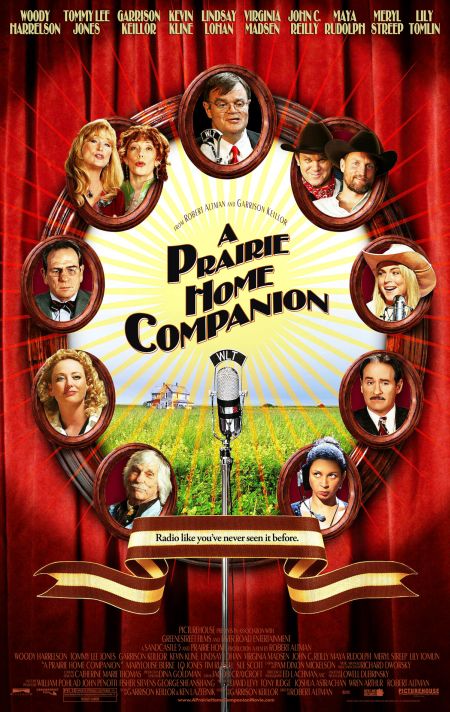
A Prarie Home Companion


A couple of weeks ago, I ventured across the river to the Midtown Cinema to see Robert Altman's newest film, "A Prarie Home Companion". I was optimistic entering the theatre, considering the cast that not only included GK himself, Garrison Keiler, but also Meryl Streep, Lindsey Lohan, Woody Harrelson, John C. Reilly, Lily Tomlin, Maya Rudolph (of SNL fame), and Kevin Kline. Fortunately, I was not disappointed.

If you've ever listened to "A Prarie Home Companion" on NPR, or watched it on PBS, this movie just brings the show to life, and adds some backstage "drama". If you've never seen or heard the show before, you'll get just as much enjoyment out of it as the experienced viewer.

The film is somewhat narrated by Kline's character, Guy Noir, who sets some of the tone for the film. Basically, the premise is that this is the final show for the cast and that the theatre will be demolished a few days after the show ends. One would hope that the film would end with the bad guys (Tommy Lee Jones, in a small cameo role) would be triumphed over and the show will go on forever. However, this isn't the case. After the show ends, the theatre is demolished. Just like they said it would. This shouldn't be a surprise though. The angel of death is literally walking among them, almost as an omen to what lies ahead for the cast and crew of "A Prarie Home Companion". This angel does take an actual life at one point, an older man who has been with the show for a long time. She also returns at the very end at the diner, we assume to take another life, although that personality is never divulged. One would assume that an angel of death might be ugly, or not as attractive as she could be. On the contrary in this case. She is always dressed in bright white and is the beautiful Virginia Madsen. She is gentle and kind and helps the cast and crew face their final hours as members of this group. (Side note: This character is billed as "The Dangerous Woman". How interesting).

While not a musical, Prarie Home Companion is full of song. The singing, done by the people on screen (no Marnie Nixon here!), isn't perfect, but it's perfect for this setting. John C. Reilly and Woody Harrelson are a dynamic duo with crude jokes about women, sex, and life in general. Meryl Streep and Lily Tomlin are excellent, but aren't they most of the time? Lindsey Lohan is quite good (I personally feel that she is underestimated in many reviews). She plays the dark and brooding (and hilarious) daughter of Meryl Streep. Personally, I just think everyone is pretty fantastic. I tend to trust Robert Altman's judgement on who he casts (M*A*S*H* anyone?).

Good film. Go see it.

In addition, if you enjoy the film, catch the radio show on Sunday's. It's intellegent and a gem of what radio was like in the early part of this century.

Monday, July 10, 2006

Pirates of the Caribbean vs. Star Wars

So, this weekend I saw "Pirates of the Carribbean: Dead Man's Chest"...twice. I really liked it. The first time I saw it with my family at the employee showing where my sister works. Woo hoo for perks.

The second time, my blogmate and i saw it together, kabitzing throughout. This entry is a result of those discussions and a blog Amanda posted 2 days ago.

To say it bluntly, Amanda and I are movie nerds. Well, nerds and general, but film is our specialty. We are huge fans of the Star Wars trilogy as well, and in our viewing of "Pirates" (she has seen it twice as well), we noticed some distinct parallels between "Pirates" and "Star Wars", especially with 'Dead Man's Chest' and 'Episode 5: The Empire Strikes Back'. If you have not seen both films, stop reading now and go to the movies, or to Blockbuster (although, if you haven't seen the 'Star Wars' trilogy at this point, you probably should just be beaten repeatedly with a copy of the VHS trilogy until you do).

Character Parallels:
William Turner (Orlando Bloom) = Luke Skywalker (Mark Hamill)
Elizabeth Swann (Keira Knightly) = Princess Leia Organa (Carrie Fisher)
Captain Jack Sparrow (Johnny Depp) = Han Solo (Harrison Ford)
"Bootstrap" Bill Turner ( Stellen Starsgard) = Darth Vader / Anakin Skywalker (James Earl Jones / David Prose / Hayden Christensen)
Davy Jones (Bill Nighy) = Emporer Palpatine (Clive Revill)
Pintel (Lee Arenburg) = R2-D2 (Kenny Baker)
Ragetti (Mackenzie Crook) = C-3po (Anthony Daniels) (please...his eye keeps falling out and c-3po is falling apart throughout the entire film.)
The following comparisons are stretches, but are worth noting just the same: Mr. Gibbs is equivalent to Chewy, and Tia Dorma is somewhat equivalent to Lando. These come mainly from their association to Captain Jack Sparrow and the other characters association to Han.

More Similarities: Well, there's the obvious similarity that Will is trying to save his father, Bootstrap, in the same manner that Luke was trying to save his father in "Episode 6: The Return of the Jedi". Both fathers are good men at heart, who simply made some poor choices that they have become physically and mentally disfigured by. Another similarity is the ships / spacecraft. Captain Jack's Black Pearl is extremely important to him, as Han's Millienium Falcon is to him (he looks like he's going to vomit in 'Episode 6' when he lets Lando, who was the original owner, fly it to destroy the new Death Star). Also, both ships were gained through somewhat scandelous means. The Flying Dutchman is equivalent to the Death Star, in ways I need not explain. Classic epic of good versus evil where the good guys are kinda bad and bad guys are very bad, blah, blah, blah. Finally to end out both films, the fates of Jack and Han are unknown when the credit's roll. Han is frozen in carbonite to be sent to Jabba the Hutt as a piece of home decor, and Jack may or may not be in the belly of the Craken (Kraken?). the Craken also looks strangely like the Sarlac from "The Return of the Jedi".

All we need for "Pirates of the Caribbean: At World's End" are some cute and cuddily creatures and a fat worm.